Wednesday, September 16, 2020

Another one about suffering, but also about death


It's an age-old question that many have asked, "if God is so good and powerful, why is there evil and suffering in the world?" I've asked this question; friends have asked this question; author and pastor Christian M.M. Brady has also asked this question. If you have a better answer to this than I have, you might just be either a genius or a lot less sensitive than you should be. 

Arguments range from the concept that suffering occurs because of free will and the consequences of sin all the way to the concept of a micro-managing god who somehow can't find a better way of inspiring people to do good than to slaughter their children. Brady, who has gone through the devastating suffering of losing a young child, doesn't offer the classic pat answers, and I find that refreshing. He admits that he doesn't know. This book is more focused on how to live with suffering and loss than on explaining why it happens. Realistically, while the reasons for suffering remain an interesting thought exercise, we really can't know why every bad thing happens. Instead, we can do as Gandalf recommends and decide what to do with the time we are given. 

I personally do not have any children. It's sort of my dream to be an aunt, but that's not the same thing. I cannot really imagine therefore, what it's like to lose a child. (I kind of hate that phrase, "lose a child" because it sort of implies that they're not really gone, just misplaced, which is kind of a sad joke). But anyway, as I read Brady's book, my thoughts turned toward my aunt and uncle whose young daughter passed away several years ago after a sudden infliction of brain cancer. To this day, they carry that grief around with them everywhere. I think that like most people, I sometimes get a little impatient with this grieving. I wish they could move on and go back to being happy and fun to be with all the time.I wish it could get better.

I wonder if grief is like chronic illness. I'm sure that I'll inevitably have the chance to compare the two since I know and love many people and one of them is sure to die eventually. My chronic illness is always hanging over my head reminding me of what once was and can never be again and I'm always finding it popping up in conversations that have nothing in particular to do with it. Like right now. While the two are certainly not the same, there is grief in dealing with loss of good health that finds a sharper tone in the grief of death.

As much as I joke about it, there is also a very real grief from the mere absence of a person in your life even if they haven't actually died. Basically, we have a lot of things to grieve about in life. And you know what? It's okay to grieve. Grieve for the loss of a friendship. Grieve for the loss of a lover. Grieve for the loss of an animal, a place, anything you may not see again or experience with the same joy and freedom. And it's okay to grieve however you think is necessary. There isn't really a wrong way to grieve. 

Obviously, the death of a child or really any loved one is one of the more devastating events in life. Grief comes from many sources, but ultimately, the question we need to ask in the face of suffering is not so much about why we must face it as what we do with it. Brady has some suggestions, which include looking toward eternity, offering comfort in the here and now, taking practical step to help mitigate the suffering of those around you and finding positive ways to remember the life and joy of those who are gone. 

Wednesday, April 22, 2020

Diction: Baby

When did humans start using the word "baby" as a term of endearment for a significant other? Just, how?

I look at a baby, and there are a lot of likable things about it, but babies are pretty much the last thing on my list of things with which to have a romantic relationship--and that list includes paintings and potted plants. Er, scratch that, there are some things that just shouldn't be on that list, and babies are one of them.

Please, love babies. Do not consider them as romantic or sexual partners. Do Not.

I asked the children what they thought of this. We listen to a lot of annoying pop songs on the radio, and I had noticed that "baby" still hasn't died out as a common hook in a song. So, I asked the children what they thought about this. The 7 year old replied that you should love your boyfriend or girlfriend as much as you love a baby, but she agreed that you don't love them in the same way. The other children didn't say much, preferring to ignore the question.

Now, on the one hand, calling a partner "baby" does signal something warm and gentle, as well as a desire to protect. This would be lovely if that were how the term were used. But consider the derivative "babe" which generally implies a voluptuous, scantily clad woman. Not someone soft and quiet and helpless.

Is this a ploy to infantalize people? To make our partners feel helpless and wimpy? Reportedly the term goes back to the 17th century at least, at which point women were very much considered inferior in many ways to men. Well, that's not okay with me.

So, what to do? I don't suppose I can convince the world to stop using the word "baby" as a romantic term, but I wish I could. I personally refuse to be called "baby" by anyone.

I was delighted to discover a EDM band that considered this and gave me back some of my pride as a human by using the word "lady" where other songs might use "baby." Obviously this would sound silly in Justin Bieber's song "baby." The word "lady" is much more formal and impersonal. But you know, words matter, and given the choice, I'd rather take the term that grants me respect and graciousness rather than one that implies that I'm a helpless sexual object.

Monday, March 9, 2020

Chronic Illness

What is Chronic Illness? 

Chronic illness is effectively always being sick. I'm sure there are cleverer definitions, but that's what it is to me. And since I'm writing this blog, I get to decide how to interpret my own answers. So there. I've been ill for about 10 years now. It wasn't so bad at first, but it has gotten worse, and now it is Noticeable.

Obviously I can't speak for everyone, but for me, my illness went like this:
1. I'm not feeling so good sometimes
2. I'm feeling downright crummy sometimes
3. I'm feeling terrible more times than not
4. I'm feeling terrible a lot of the time.
5. I rarely feel good.

Today happens to be a good day. I'm in pain, sure, but I'm not depressed and I'm able to function mostly like a healthy human being. I can get out of bed, I can eat food. I can listen to sounds. I can workout at the gym. I can play with the children. I can do work. I can socialize.

Yesterday happened to be a bad day. I barely got out of bed. I lied to everyone who asked me how I was doing. I finished my day by crawling from the couch to the bed and spending 9 hours tossing and turning while I tried not to cry or throw up. I admit that yesterday was the first time that I was in so much pain that I reacted by puking. I'd kind of like that to not happen again, but I don't know that I can do much about it.

What's it like having a chronic illness?

Again, not to speak for everyone, but in my experience, dealing with the pain isn't actually the hardest part of having a chronic illness. Human bodies and brains are amazingly resilient. You stub your toe, and your nervous system goes YIKES! but then your brain says, no, it's okay, we can still walk. On with the football game! I'm in pain like 98% of the time, but I honestly sometimes sort of forget that I'm in pain because my psyche is like, dude, we have other things to think about. Like, I go to yoga class, and the instructor asks us to do a down dog, and I have to stop and think about it, hmm, are my wrists feeling good enough to support half my body weight right now? Nope. Rarely. But the pain isn't constantly pressing me down. It could certainly be worse, and I know that some people do deal with constant noticeable pain, but it remains incredible how much pain human beings are capable of dealing with once we realize we can't do anything about it.

No, the hard parts of chronic illness are things like waking up in the morning and counting your spoons (aka, emotional energy), and realizing you'll never be able to get everything done because you just don't have it in you today. Things like meeting someone new and trying really hard to find things to say that don't have anything to do with illness, even though it's a huge part of what you think about most of the time, but you don't want them to immediately think of you as a sick person. It's things like being afraid to make appointments because you don't know if you'll be feeling up to it that day and you hate feeling like a flake. It's things like people asking how you are, and secretly knowing that you'll never be able to honestly say "good," but you kind of have to because there's no point in getting into the whole story in passing. It's knowing that you might never get better, no matter how many good wishes are sent your way. It's when people eventually stop sending flowers and cards because "get well soon" doesn't stand up against the permanence of the illness. It's the loneliness. It's the depression. It's the helplessness. 

What can you do to help?

Well, you can care.


Saturday, February 8, 2020

Shrieking History

I was going to start with something nostalgic about my blog's 3 year anniversary, but that's both sappy and inaccurate, so I'll say instead that a lot has changed over the last 3 years. One thing that hasn't changed is that I'm still lonely.

Oh, girl, you're going to start with that?

I'm just going to post these here and you can decide for yourself:


I don't mean that anyone should feel sorry for me. Lord knows I already feel sorry enough for myself, and that's a dumb place to sit in. I've been glancing over my history and all that nonsense and it's cuttingly obvious that I crave close friendships and have for most of my life. My therapist keeps bringing it up as if it were some sort of amazing revelation, but I know that I'm alone. And I know that it's not good for me.


Sometimes something happens, and you're like, yes, I belong here and this is right and even though I had 6 panic attacks and got into 3 car accidents before I was able to bring myself here, I'm so relieved that it was the right thing to do. And then you go home feeling happy and all that. But the next day you come back and you find the door shut. You can never get back again. It gets to the point where you don't want to go anywhere at all. You don't want to try to belong. You can't bring yourself to want to be wanted because even though you know it's what you need, you can't bear to lose and lose and lose again. Kate DiCamillo tells us that the heart lives by breaking. That's what a heart does. But the more you break, the more you wonder if anyone ever breaks for you?


Maybe it wasn't meant to be. Maybe that's not how hearts are created. Sora might be able to go around filling his heart with bits of other's, but despite all the broken pieces out there, it seems like nothing ever fits in me. We scatter and we dream and we stand waiting, but sometimes, nothing happens. We simply stay there in the cold wondering where are the pieces that are meant to fit in to make us whole.

Friends, I might be wrong, but I'm pretty convinced that people weren't meant to live alone. People weren't meant to live believing that they are worthless and unnecessary. People shouldn't have to just do things for attention or live on the edges or watch ships in the night pass them by. Movies and books and video games are filled with heart-wrenching stories of a crazy coincidence that brings together companions, lovers, and friends. But it turns out that the reason these stories are so compelling is that each of us wants that closeness with someone. Each of us wants to be loved and respected and wanted. But in the whole wide world, the chances of running into the someone whose broken pieces fit perfectly with your own are incredibly small. 

So we throw ourselves against the walls. We smash shards of hearts into our chests believing that close enough is good enough and that as long as we can ignore the bleeding, the wholeness will eventually come. 

Friends, I'm not just a bunch of letters on an internet page. I'm a person. I'm a cosmic being full of hopes, dreams, sorrows, pains and stories. I want to know and be known. This isn't a cry for help. But if you find yourself in the same sort of place, which we all do at some time or another, don't let's each be lonely separately. I'm not that hard to find. 

Much Love Always,
♥


Saturday, January 25, 2020

Remarkable Literature

It's rather remarkable that one can read hundreds of pieces of good literature and be unable to find the words to say why they are good. But then one reads a bit of bad writing, and suddenly it becomes clear. Good literature is not this. I admit, therefore, that I have been reading A Song of Ice and Fire. It is not my intention in any way to come across as a hater, so I won't review said book here. However, it may be worth note that of the points I bring up in the following paragraphs, few if any apply positively toward that particular book.

What makes a good piece of fiction? I suppose there are many views on this. In my opinion, there are 2 overarching themes to what comprises a good book; namely the quality of individual elements and the way the book makes one feel. I'll break down the elements later on, but I think that feeling is more important in the making of a good book than any one element. A good book makes one feel something. If you walk away and forget the book, chances are it wasn't good. I have dozens of books on my "read" list that I glance at the covers and wonder what that book was about anyway. There is not much likelihood that any of them would qualify for "good books" on my list. This, naturally varies from person to person, and in fact, 10 years ago I reviewed a certain series as good which I can now pick apart and say it is a dramatic failure as a good book. The bottom line is that if a book does not inspire some sort of emotion, all the words are basically wasted. Sure, there may be facts and quotes and all sorts of technical goodnesses, but if feeling is key, anything that obscures it makes the book worse.

A Song of Ice and Fire does, in fact, inspire a lot of feeling. One point in its favor. But there is a strong difference in the feeling of, for example, the Girl Who Drank the Moon, Love That Dog, The Magician's Elephant, or Anna Karenina. These books all inspire strong feeling in me. It isn't always positive feeling (see me sitting on a bench at the blood donation center bawling my eyes out to Love That Dog or gasping in pain as I literally commit suicide with Anna), but there is a sense that they are wholesome. They are real. They are true. And although they aren't always pleasant, there is a sense of nobility, understanding, and overarching honesty to them that makes me feel more human.

Compare this to the feelings I get from Fire and Ice: despair, loss, confusion, a sense that no matter how much good is in the world, those who are powerful can follow their selfish and lustful whims without consequence. This book makes me feel depressed. While there is certainly a lot that is depressing in the world, I have reason to believe that good can triumph over evil, and that selfishness and lust are not the only controlling forces in this world. But, as I've said before, if that's the sort of thing you like, then feel free to like it.

Anyway, everyone feels differently, and that's fine. While I think that Ice and Fire will always be popular, I'll never get on the bandwagon with the series. I'm also pretty sure it will never make it to the shelf of "great classical literature." This is primarily because it doesn't score well on the elements of good writing: characters, plot, writing style, pacing, dialogue, believability, imagination, value and themes.

Now, I am going to say right away that personally I have loved many a book that scores a fat zero in all categories except characters, but I still call it a good book. This is because people matter. A book can hardly be good if there's no connection, no understanding, no revelation. In fact, one of my favorite examples of characters is We Have Always Lived in a Castle, a classic gothic horror. This book meanders on for a long time in a confused, inexplicable mayhem, but suddenly, at the end, you realize who you've been dealing with, and it's like a clap of thunder. I can't say I love the book. It is sinister. But I consider it good because after all that time, I could connect with the characters, and that made it believable. There are a lot of other things going on in that novel that I don't have time to address here, but I have to say that believable, likable or at least interesting characters are the hallmark of good literature. No novel can truly be good if it lacks at least one good character.

Next we can discuss plot. I honestly don't have much to say on this topic because in my opinion every plot that has ever been imagined has, in fact, been written about somewhere, and there is very little likelihood that anything can happen in a book that will surprise me. This is what happens when you've literally read thousands of books. What makes a plot interesting is not so much whether it has a beginning, climax and resolution, although those items are important, but how the author writes about these items. Hence the next two elements.

Pacing and writing style are separate entities, but I'll treat them here together because I have much the same thing to say of each. Writing style, voice, tone, syntax and related items factor greatly into pacing in any case, because if one writes in a comical tone with medium pacing, it loses a lot of its effect. If one is factual and long-winded, it makes for a very heartless read. While I do have some favorite styles of writing personally, both pacing and writing style are contingent on content, and while one can have brilliant style, it falls flat if it's a poor match with the characters, plot and general writing.

Dialogue is sort of a sub-category of both writing style and characters. Good dialogue is interesting, believable and helps advance either plot or character development. While some critical background is helpful at times, it's easy to lose interest in a story if none of the dialogue makes sense for the person who is saying it.

IDK, I could go on. I feel like I've touched on believability. Books have got to be captivating, and there has to be something tangible in there to make them so. Imagination would seem to be an opposite of that, but they actually play together well, balancing each other to stretch the limits of what should be possible.

I'm not sure what to say about value and themes that I haven't said about feelings already. But basically, if a book makes me feel like garbage for reading it, it doesn't matter what else it has done right.

So, anyway, that's my 2 cents or whatever. Sorry I'm finishing this so lamely, but I've got a lot of Don Quixote to finish before I have to return it to the library on Tuesday, so I'll talk to youse later.


Monday, January 6, 2020

2019 Book Review

Well, friends, I haven't become an influencer yet, but I don't suppose that matters when I merely want to share my opinions. I guess I do a lot of things, but I don't think I'm very good at most of them. One thing I excel at is reading books. I had set a goal to read 120 books (each at least 30 minutes long) in 2019, and I'm rather proud of myself for exceeding that goal. I can't really pick a favorite, so I shall simply list the titles in reverse order of reading. For the upcoming year, I'm working toward 160 books, and I must say I'm off to a great start. Anyway, without further ado, here are my top book recommendations out of books I read in 2019.


Chernobyl 01:23:40: The Incredible True Story of the World's Worst Nuclear Disaster
Andrew Leatherbarrow

This book is precisely what the title would indicate. Unlike many of the stories I've glimpsed on the subject of nuclear disaster, however, this non-fiction work is very clearly an extended research paper. It shed a lot of light into something I might never have thought about otherwise, and I'm glad my ebooks library recommended it to me.

We Have Always Lived in the Castle
Shirley Jackson

Part of my Halloween reading challenge, I discovered this old classic. As far as horror genre books go, this one is not at all graphic or tense, but it is disturbing. I enjoyed the unique look into the mind of what must be insanity, but then also must not be. I'll be thinking of this book long after October.

Jaclyn Hyde
Annabeth Bondor-Stone

A surprisingly moving take on the classic Jekyll and Hide theme, this book was best appreciated after I read the old classic. Basically there were a lot of inside jokes that had made me glad to have read the classic. Going back to Bondor-Stone's rendition, however, I can't say it was terribly complicated, but it was certainly thought-provoking and had a few smiles along the way.

A Possibility of Whales
Karen Rivers

According to the author, this novel is meant to be a modern take on "Are You There God? It's Me, Margaret" by Judy Blume. While I can't say I enjoyed Blume's description of coming to age, Rivers takes a variety of complex themes and weaves them into something rather poetic. Although menstruation certainly comes up, it is treated with dignity and understanding, which is something that is unfortunately lacking in so many young adult novels.

Solving for M
Jennifer Swender

Middle school can be a puzzling time for young people. Mika faces a lot of stressful things in her life, not the least of which is math class. With care and cleverness, Jennifer Swender navigates through a sincerely engaging tale of family troubles, uncertain classroom situations and amusing teachers and manages to teach some quality math along the way.

Herding Cats
Sarah Andersen

Well, if you are a woman living in today's society, please read this book.

Refugee
Alan Gratz

Well, I never knew much about the refugee crises discussed in this book. While the novel itself is rather biased and is definitely a dramatization, it reflects often-ignored historical facts that I found fascinating to look up later.

One Flew Over the Cuckoo's Nest
Ken Kesey

Sure, this is an adult-themed book, in more ways than one. I can't help but stop to think about this one. How are the mentally ill treated today? We've all read horror stories of old insane asylums, and hopefully we've all been duly disgusted that people could be treated that way. But where is the value for human life? Regardless of how difficult a person is.

The Help
Kathryn Stockett

Well, I don't want my whole list to be full of books about social justice. But while it wouldn't be hard to put The Help into that category, there's so much more to this book than racial discrimination. The book itself is a deep appeal for someone to recognize that there was injustice that was never considered, and discrimination continues to be ignored. The perspective was certainly thought-provoking. It makes sense that this novel made a best-sellers list.

The Count of Monte Cristo
Alexandre Dumas

So, if you don't like long reads full of a variety of interwoven concepts that are hard to follow, find a shorter book. While this one doesn't even make the top 100 longest novels ever written, I feel pretty proud of myself for getting through to the end. Not only is this book full of history and culture, the fascinating characters and intricate plot continue to be lovable and relevant today. I hope this one never gets forgotten.

Sex or Ice Cream?: Secrets of an Asexual; Asexuality in a Sexed Up World--A Thorught-Provoking and Comically Quirky Memoir
Ana Navarro

Why, yes, the title of this one might be longer than the book itself. And, yes, there are spelling and grammar errors, but really, guys, this little novella has a lot of heart and adds a little more understanding into the world of sexual orientation. It's only a dollar on Amazon, and I'm satisfied with every penny I spent on it.

The Search for Delicious
Natalie Babbitt

I'm counting this one for 2019 even though I've definitely read it in other years. Honestly, there aren't that many classy, thoughtful, and lighthearted fairy tales in this world. Naturally, this one comes with a moral, but it is cheeky and fun to read. I love it as a bedtime story and a pleasant escape from all the deep thinking of more mature literature.

The Art of War
Sun Tzu

How to explain why I picked up this slim volume? Wow, it's just worth the read. Looking at Tzu's advice, I kind of want to smack my head, like, duh, but how easy it is to lose track of basic logic in the business of life. I'd read it again. And probably again because I fell asleep after the first paragraph :)

Summer Bird Blue
Akemi Dawn Bowman

Okay, I lied, I saved the best for last. If this one doesn't make it to the top of everyone's favorites list, you have no heart. Summer Bird Blue is unlike any book I've ever read. It reaches almost Tolstoy level of empathy. The main character, Rumi, goes through so much in this book, and you, the reader, go right along with her, trying to cry, learning to play the ukelele, lying on the floor staring at the ceiling fan, and screaming obscenities into the dark. I've read a lot of books this year, but this one is very much on the top of my list to purchase and read every year and foist upon others. So, yeah, if you don't read any other book on this list, please love this one.


Reading Challenges

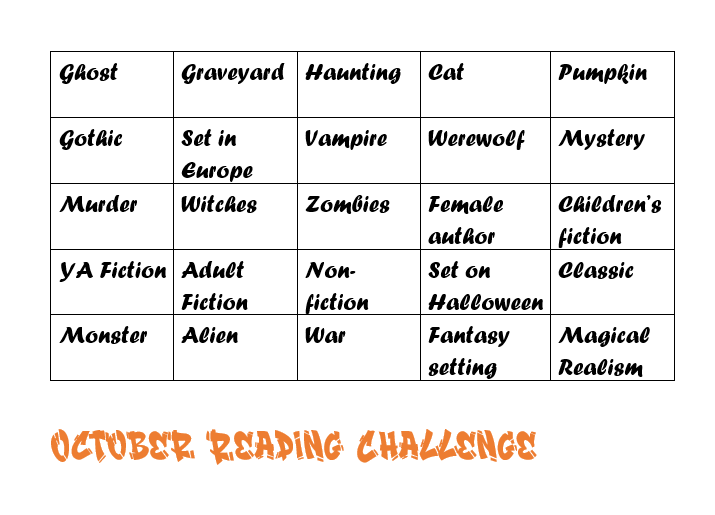
I don't know if you're into reading challenges, but if you're the sort of person who likes this sort of thing, then this is the sort of thing you'll like. I don't do reading challenges every month, but I have a few that are dear to my heart, so I'll post them here in case you want to join me :) Many of them are set up as bingos, but you can also play for points in general, since many books fulfill more than one challenge, or you can just use the lists for inspiration.


Also, please appreciate the one that started it all: https://utopia-state-of-mind.com/a-spec-readathon-reading-list/?fbclid=IwAR0EDjQ6mOCp2OMpZoi6RryabVjOuhm-2v-xeJGMLA0_Oh7L0hFkpkPPAM4


and if you'd like, you can follow my progress in 2020 on my Goodreads page 2020 Reading Challenge

Thursday, October 31, 2019

Diction: Want versus Need

While searching for the perfect ingredients for a poisoned apple beverage, I informed a shopkeeper that I needed a candy apple. The man replied, "are you sure you need it, or do you just want it?" I'm sure I had to come up with a silly comeback because that is a silly question.

I understand that we teach children this distinction because they tend to exaggerate their desire for a new toy or snack or whatever fancy takes root in their brains at the time. Need is a strong term, but I think that it's foolish to continue questioning need versus want for one simple reason.

Need implies a condition. I need X in order to X. Technically speaking, no one ever needs anything. You might need food, but only in order to survive. If you don't care to survive, eating is no longer a necessity. You might need a raise, but only in order to avoid going broke. If you don't care whether you're homeless and in debt, getting a raise no longer becomes a need.

Need becomes confused with want when the result is something awkward or unecessary. For example, I need to eat a piece of candy so I can enjoy its flavor. I need to see a new movie in order to be able to talk about it with my friends. I need a candy apple in order to make the perfect poisoned apple beverage. Need, therefore, is not about how badly you want the thing you reportedly need, but how important and specific the result is. When a child needs a new toy, they might mean they don't think they can be happy without it. But as an adult, I can look at the situation from a different perspective and note that happiness is entirely possible without the new toy. A "need" for a new toy in order to be happy is not specific (happiness can be achieved in other ways) or important (it's okay to not be happy sometimes). 

Truly, I don't need to concoct the perfect poisoned apple beverage. The result of concocting said beverage is that I will feel slightly more accomplished and will have enjoyed my time with friends at the Halloween party just a little more. But I don't need any of those things. Accomplishment and enjoyment are not necessary to my being. However, if the results clause is "in order to create this beverage" as an end in itself, then, yes, I need a candied apple, because it is impossible to make the drink without one.

Anyway, kiddos, the point is that it's okay to need things. People question your motives and objectives, but if, in order to achieve a desired outcome, you need a certain thing, then it is perfectly appropriate to use that word. Saying, "I want a candied apple" would have been untrue in the above circumstance, because I don't, in fact, like candied apples. Saying you want something makes the thing an end in itself. You don't want something in order to accomplish something else. Want is intransitive.

This distinction between wants and needs is not framed properly when we say, "you need food, but you don't need a new toy." It is equally true that you might want food and want a new toy. However, there is an implied results clause in each. It would be more true to say, "you need food to be comfortable, but you don't need a new toy to be comfortable."